Why Your Hands and Feet Swell During Hot Yoga
Quick Answer: Heat makes the blood vessels near your skin dilate to dump heat, gravity pulls fluid toward the hands and feet, and the muscle pumping that normally moves it back is limited when your arms are held out or overhead. Add sodium loss from heavy sweating and the fluid tends to stay in the tissue. It is normally harmless and settles within an hour or two. Sudden one-sided swelling, or swelling with breathlessness or chest pain, is not normal and needs medical attention.
Most of it is manageable with sodium, hydration, and how you use your hands during class.
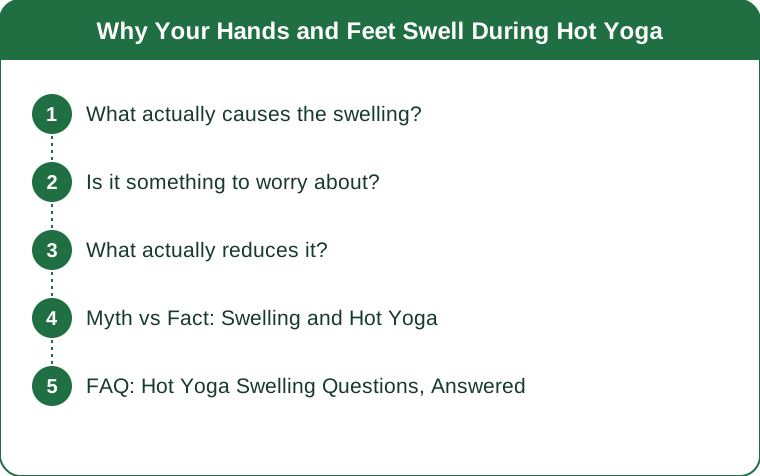
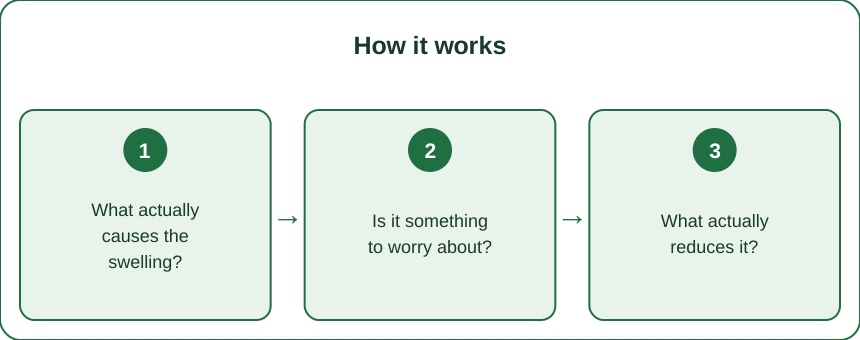
What actually causes the swelling?
Four mechanisms stacking on top of each other, all of which are strongest in exactly the conditions a hot yoga room creates.
Peripheral vasodilation. To lose heat, your body opens the blood vessels near the skin, particularly in the hands and feet, which have a high surface-area-to-volume ratio and a rich vascular supply. More blood in those vessels means more pressure pushing fluid out into the surrounding tissue. This is the main mechanism and it explains why it is a hot yoga phenomenon rather than a yoga phenomenon.
Gravity and posture. Fluid pools in whatever is lowest. In a class with long standing sequences and arms extended out to the sides or hanging down, your hands are held in a position where fluid arrives easily and leaves slowly.
Limited muscle pump. Veins and lymphatic vessels rely heavily on surrounding muscle contraction to push fluid back toward the centre of the body. Holding a static pose with arms extended produces sustained low-level contraction rather than the rhythmic pumping that actually moves fluid. This is why swelling is more associated with long static holds than with dynamic flow.
Sodium loss. Heavy sweating in a hot room loses a meaningful amount of sodium. If you replace that fluid with plain water, the sodium concentration in your blood drops slightly, and fluid shifts out of the bloodstream into the tissues. This one is worth flagging because it is the mechanism most under your control and the one most commonly mishandled.
Why it varies so much between people: individual differences in sweat sodium concentration are large, some people vasodilate more readily, hydration status going in matters, and hormonal fluctuations across the menstrual cycle affect fluid retention noticeably. Someone experiencing this every class next to someone who never does is entirely normal.
Is it something to worry about?
Usually not - but there is a specific list of exceptions, and they are worth knowing precisely rather than vaguely.
Normal and expected:
- Both hands or both feet, roughly equally
- Coming on during class, easing within an hour or two afterward
- Rings feeling tight, fingers feeling full or stiff
- Mild, no pain
- More noticeable in hot weather, after a heavy sweat, or before a period
Worth getting checked:
- Swelling on one side only. Asymmetric swelling, particularly in one leg, is the presentation that matters most and warrants prompt medical attention.
- Swelling with pain, redness, or warmth in one limb.
- Swelling accompanied by breathlessness, chest pain, confusion, or severe headache. In the context of heavy sweating and drinking large amounts of plain water, confusion, nausea, and headache can indicate hyponatremia - dangerously low blood sodium - which is a medical emergency.
- Swelling that persists overnight or into the next day.
- Swelling that has recently started when it never used to, or is progressively worsening.
- Any swelling if you have known kidney, liver, heart, or thyroid conditions, or are pregnant, where fluid retention needs different interpretation.
The useful mental rule: symmetric, temporary, and painless is the normal picture. Anything one-sided, persistent, or accompanied by other symptoms is not, and is a doctor’s question rather than a yoga question. This is general information, not medical advice.
What actually reduces it?
In order of how much difference each makes.
1. Replace sodium, not just water. The highest-leverage change and the one people resist. If you sweat heavily in class and drink a litre of plain water afterward, you are diluting sodium at exactly the moment you need it. Use an electrolyte drink, or eat something salty afterward. A pinch of salt in your water bottle is enough for most people. If the swelling is significant and regular, this alone frequently resolves most of it.
2. Arrive properly hydrated rather than drinking heavily during class. Dehydration going in makes everything worse, and large volumes of plain water during class contribute directly to the sodium dilution problem. Drink steadily in the hours before, sip moderately during.
3. Use your hands during class. Simple and effective. Make a fist and release it a few times during standing sequences. Spread the fingers wide in poses where your hands are free. Lower your arms briefly between poses. Each of these engages the muscle pump that returns fluid, and none of them disrupt the class.
4. Take rings off before class. Practical rather than preventive, but a ring that will not come off a swollen finger is genuinely unpleasant and occasionally requires help to remove. Take them off with your shoes.
5. Elevate afterward. Ten minutes lying down with legs up a wall - a pose most yoga practitioners already have - uses gravity in your favour and clears lower-limb swelling noticeably faster.
6. Move after class rather than sitting down immediately. A short walk activates the calf pump, which is the main mechanism for moving fluid out of the feet and lower legs. Sitting in a car for thirty minutes right after class is the worst option available.
7. Cool down gradually. The vasodilation persists while you are hot. Ten minutes in a normal-temperature space before you head out lets vessels return toward normal in an orderly way.
Myth vs Fact: Swelling and Hot Yoga
Myth: Swelling means you are dehydrated. Fact: It can accompany dehydration, but the direct cause is fluid shifting into tissue rather than a lack of fluid. Drinking more plain water in response frequently makes it worse, because it dilutes sodium further. If you take one thing from this article, take that one.
Myth: It means you drank too much water. Fact: Sometimes true, and not the whole story - vasodilation and gravity would produce some swelling regardless. Excess plain water makes it worse rather than causing it.
Myth: It is a sign you are not fit enough for the class. Fact: Unrelated to fitness. Experienced practitioners get it too. Individual differences in sweat sodium and vascular response are the main drivers, and neither improves much with training.
Myth: Compression gloves or socks will fix it. Fact: Compression genuinely helps with lower-limb swelling in some contexts, but wearing compression garments in a 38-degree room impairs heat loss, which is counterproductive. Use them afterward if at all, not during.
Myth: If it happens, you should stop doing hot yoga. Fact: For the normal symmetric temporary version, no. It is a predictable physiological response to heat, and manageable. The exceptions listed above are different and do warrant stopping and getting checked.
FAQ: Hot Yoga Swelling Questions, Answered
Why does it seem worse in some classes than others?
Room temperature varies more between classes than people assume, and so does your starting hydration, what you ate, and where you are in your cycle. A hotter room, a saltier previous day, or a longer class all shift it. It is rarely about the sequence.
How long should it take to go away?
Usually within one to two hours after class, and certainly by the next morning. Swelling still present the following day is outside the normal pattern and worth mentioning to a doctor.
Does it get better as I do more classes?
Often, yes. Heat acclimation over two to three weeks includes a reduction in sweat sodium concentration and more efficient cardiovascular responses, both of which reduce the effect. New practitioners typically notice it most in the first few weeks.
Should I take an electrolyte drink during class or after?
Before and after works well for most people. Sipping something with electrolytes during a long or particularly hot class is reasonable too. What to avoid is large volumes of plain water during class on an already low-sodium day.
Is it different in winter?
Mildly. Cooler ambient conditions outside the studio mean you cool down faster after class, which shortens the episode. But the room is the same temperature, so the in-class mechanism is unchanged.
TL;DR:
- Heat dilates the vessels in your hands and feet, gravity pools fluid there, and static poses limit the muscle pump that returns it.
- Sodium loss from heavy sweating, replaced with plain water, shifts more fluid into the tissue - the most common and most fixable contributor.
- Symmetric, painless, and resolving within a couple of hours is the normal picture.
- One-sided swelling, pain, or swelling with breathlessness, confusion, or severe headache needs medical attention rather than a hydration tweak.
- Fixes: electrolytes rather than plain water, hydrate before rather than during, open and close your hands in class, walk afterward, legs up the wall.
Take your rings off with your shoes, and put salt in the bottle. That covers most of it.
See It in Motion
Seen here: High Waist Yoga Leggings with Side Pockets — shop it on bubblelime.com
Keep Reading
This article is for general informational purposes only and is not medical advice. Always consult a qualified health professional for guidance specific to you.