Why You Feel Fine in Hot Yoga and Wrecked Three Hours Later
Quick Answer: The delay is the diagnostic. Immediately after a hot class you are running on endorphins, elevated core temperature and the vasodilation that follows heat exposure, all of which feel good. Two to four hours later, the actual fluid and sodium deficit registers. Losing one to two litres of sweat and replacing it with plain water leaves you with less total sodium and a diluted blood concentration, which produces headache, fatigue and poor concentration on almost exactly that timeline.
If you feel great at 11 and terrible at 2, the intervention belongs in the fifteen minutes after class.

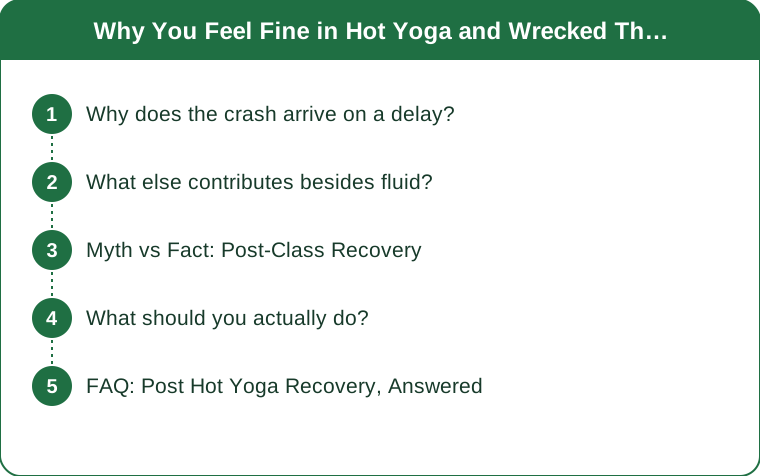
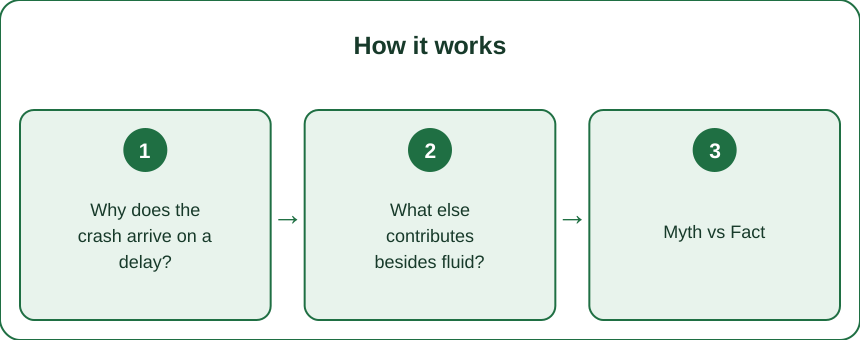
Why does the crash arrive on a delay?
Because the things that make you feel good immediately after class are short-lived, and the things that make you feel bad take hours to register.
Immediately after: core temperature is still elevated, peripheral blood vessels are dilated, endorphin and endocannabinoid activity is raised, and you have just completed something demanding, which produces a genuine mood effect. This combination reliably feels excellent for roughly thirty to ninety minutes.
Then it unwinds. Core temperature normalises. Vasodilation resolves, and as it does, the reduced blood volume from fluid loss becomes functionally apparent rather than masked. Blood pressure regulation gets harder, particularly on standing.
And the sodium problem builds. Sweat contains sodium, typically 20 to 60 millimoles per litre and higher in unacclimated people. Losing 1.5 litres of sweat can mean losing well over a gram of sodium. Replacing that with a litre and a half of plain water restores volume while diluting concentration further, which is the worst of both.
The body’s response is to excrete some of the water to protect concentration, which means you urinate frequently after class, feel like you have hydrated well, and remain in deficit.
The two-to-four-hour timeline matches the time it takes for that sequence to complete, which is why the symptoms are so consistently reported at that interval rather than immediately.
And the classic set of symptoms, dull headache, heaviness, poor concentration, sometimes mild nausea, is the recognised profile of mild dehydration with sodium depletion rather than of exercise fatigue.
What else contributes besides fluid?
Three secondary factors, each of which is easy to miss.
Blood glucose. Hot classes are frequently taken in the morning, often fasted or after something small, and glycogen use in a ninety-minute class is meaningful. A low blood glucose contribution shows up on a similar timeline and produces overlapping symptoms. If eating something changes how you feel within twenty minutes, this was part of it.
Thermoregulatory cost. Cooling from an elevated core temperature is metabolically active work that continues after class. Your body is still doing something for a while, which is part of why post-class fatigue is greater than the exercise intensity alone would suggest.
The heat and blood pressure interaction. Prolonged heat exposure lowers blood pressure through vasodilation, and for people who already run low, this can persist for hours and produce light-headedness on standing that is often mistaken for tiredness.
And sleep and caffeine, which interact with all of the above. A caffeinated pre-class coffee with no food, followed by a heavy sweat session and plain water, is close to a worst-case combination and is also an extremely common one.
One thing that usually is not the cause: overexertion. The crash pattern presents identically after an easy class and a hard one, which is a strong clue that intensity is not the variable.
Another that is not: toxins. Sweat is water and electrolytes with trace amounts of other substances, and the detox framing has no bearing on why you feel bad at two in the afternoon.

Myth vs Fact: Post-Class Recovery
Myth: Drink as much water as you can after class. Fact: large volumes of plain water after heavy sweating can worsen the sodium dilution and increase urine output, leaving you no better hydrated. Volume matters, and so does what is in it.
Myth: Sports drinks are for athletes, not yoga. Fact: a ninety-minute hot class can produce sweat losses comparable to a long run. If your clothes are soaked, the losses are athlete-scale regardless of how the activity is categorised.
Myth: You can tell you are hydrated because you needed to urinate. Fact: frequent clear urine after heavy sweating can indicate that you are excreting water to protect sodium concentration. It is not proof of good hydration.
Myth: The heaviness means you worked hard. Fact: it correlates far better with fluid and sodium status than with class intensity.
Myth: Coconut water is a complete replacement. Fact: it is high in potassium and relatively low in sodium, and sodium is the electrolyte you lose most in sweat. It is pleasant and it is not a targeted solution.
Myth: You just need to get used to it. Fact: acclimation reduces sweat sodium concentration and improves the situation meaningfully, and it does not remove the need to replace what you lose. Acclimated people sweat more, not less.
Myth: A protein shake covers it. Fact: it helps with the food side and typically contains little sodium. Add salt to the meal after class, which is the simplest version of the whole fix.
What should you actually do?
Weigh before and after, once. Not as a routine, just once to calibrate. Each kilogram lost is roughly a litre of sweat. Most people are startled by the number, and knowing it makes the rest of this concrete rather than theoretical.
Replace roughly 1.25 to 1.5 litres per kilogram lost, over the following two to four hours rather than all at once. The extra accounts for the urine you will produce.
Include sodium. An electrolyte tablet, a proper rehydration solution, or simply a salty meal within an hour. The salt is doing more work than the water in this specific scenario.
Eat something with carbohydrate within an hour. It addresses the glucose contribution and it improves fluid retention, since carbohydrate and sodium together enhance absorption.
Pre-hydrate rather than catching up. Around 500ml in the two hours before class, with some sodium if you are a heavy or salty sweater. Starting in deficit guarantees finishing in a larger one.
Cool down deliberately. Ten minutes in a cool environment before dressing and leaving. It shortens the thermoregulatory tail and reduces the continued sweating that happens in the changing room, which is a genuine additional loss most people do not account for.
Test the sodium theory directly. Next class, do everything the same except add proper electrolytes afterwards. If the two o’clock crash does not arrive, you have your answer in one session.
And see a doctor if it does not resolve. Persistent post-exercise fatigue, headaches that recur despite good hydration, or dizziness on standing that continues into the next day are worth investigating rather than managing with more water. Low iron and thyroid issues both present this way and both are common. This is general information, not medical advice.
FAQ: Post Hot Yoga Recovery, Answered
How much do people actually sweat in a hot class?
Commonly 1 to 2 litres in ninety minutes, and more for larger or unacclimated people. Weighing before and after is the only way to know your own figure.
Is an electrolyte tablet enough?
Usually, combined with food. Look for one with meaningful sodium, several hundred milligrams, rather than one that is mostly magnesium and potassium.
Why do I get the headache even when I drink loads of water?
That is the classic presentation of the sodium dilution problem. More water is the wrong lever; sodium is the right one.
Should I skip the class if I slept badly?
Not necessarily, and expect it to feel harder and be more careful about heat symptoms. Sleep deprivation reduces heat tolerance measurably.
Does this happen less as I get acclimated?
Yes, noticeably, because sweat sodium concentration drops and plasma volume expands. It reduces the problem rather than removing it.
Is the afternoon crash ever something else?
It can be. Low blood glucose, low iron, thyroid problems and poor sleep all produce a similar pattern. If good rehydration does not fix it within a couple of weeks, get it checked.
TL;DR:
- Endorphins, elevated core temperature and vasodilation mask the deficit for the first hour or so.
- Replacing 1 to 2 litres of sweat with plain water dilutes sodium, and the symptoms register two to four hours later.
- Frequent clear urine after class is not proof of hydration; it can be the body protecting concentration.
- Weigh before and after once, then replace 1.25 to 1.5 litres per kilogram lost, with sodium, over a few hours.
- Eat carbohydrate within an hour and cool down properly before dressing.
- Test it in one session: change only the electrolytes and see whether the crash arrives.
The class was fine. The fifteen minutes after it were the problem.
See It in Motion
Seen here: High Waist Yoga Leggings with Side Pockets — shop it on bubblelime.com
Keep Reading
This article is for general informational purposes only and is not medical advice. Always consult a qualified health professional for guidance specific to you.