Why Hot Yoga Feels Hardest the Week After a Short Break
Quick Answer: Heat acclimatization decays fast, much faster than fitness. The plasma volume expansion that made hot classes manageable begins fading within 3 to 5 days and is largely gone by 2 to 3 weeks. Your sweat onset threshold rises back up, your heart rate at a given effort climbs 10 to 20 beats, and the room feels significantly hotter than it did. None of that reflects lost strength or flexibility. It rebuilds in roughly 5 to 10 sessions, faster than it took to build the first time.
You took ten days off. A holiday, a work stretch, a cold. Nothing dramatic.
You come back and by minute 15 you are on your mat wondering what happened. Your strength has not measurably changed in ten days. Something else did.

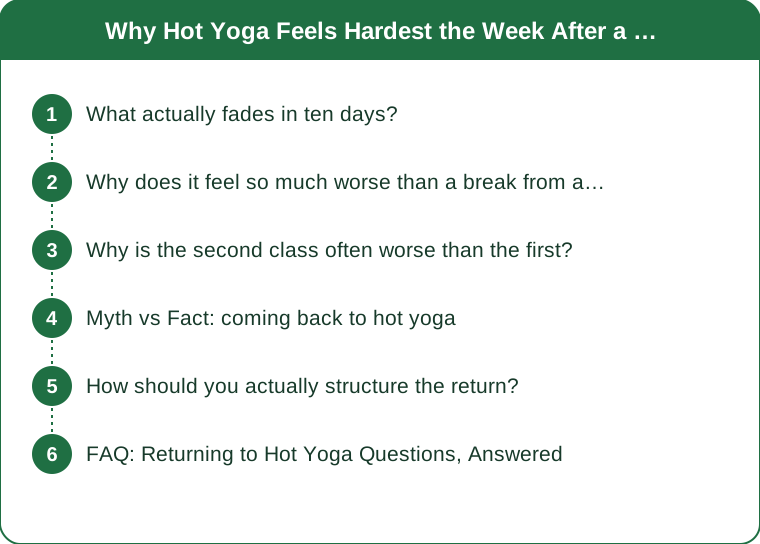
What actually fades in ten days?
Heat acclimatization, and it fades on a much faster timeline than most people realize.
The adaptations that make a hot room manageable are a specific set, and they are maintenance-dependent:
Plasma volume expansion. After a couple of weeks of regular heat exposure, your plasma volume increases by roughly 4 to 15 percent. More circulating fluid means better cardiovascular stability under heat stress and a lower heart rate at any given effort. This one starts decaying within 3 to 5 days of no heat exposure and is largely gone by 2 to 3 weeks.
Lower sweat onset threshold. Acclimatized people start sweating earlier, at a lower core temperature. That early start is what keeps core temperature from climbing steeply. The threshold rises back within 1 to 2 weeks off.
Sweat sodium conservation. The most durable adaptation, often partly intact for 3 to 4 weeks.
Perceptual adaptation. Genuinely a thing. Regular attendees rate the same room temperature as less unpleasant. That, too, fades.
Ten days off puts you right in the window where the first two are largely gone and the third is partly intact. Which produces exactly the experience people describe: you are not cooling well, your heart rate is high, and the room feels hotter than the thermostat says.
Why does it feel so much worse than a break from a non-heated class?
Because two things fade at very different rates and you are only expecting one of them.
Take ten days off from strength training. Strength barely moves. Muscle mass barely moves. You might feel a bit rusty and be back to baseline in two sessions.
Take ten days off from a hot class and the strength component behaves exactly the same way, essentially unchanged. But the thermoregulatory component has lost most of its adaptation.
Your brain attributes the whole experience to fitness, because that is the framework it has. So a heat problem gets read as a fitness problem, which is discouraging in a way that is completely unwarranted.
The specific numbers make the case. In an unacclimatized state, heart rate at a given workload in heat runs 10 to 20 beats higher than in an acclimatized one. Perceived exertion tracks heart rate closely. So the same sequence, at the same strength level, genuinely feels substantially harder, and there is nothing psychological about it.
Why is the second class often worse than the first?
This surprises people and there is a reasonable explanation.
On the first class back, you have residual adaptation, novelty motivation, and full glycogen. You push through.
On the second, usually 24 to 48 hours later, you are carrying fatigue from the first, you may still be slightly fluid-depleted if you did not replace what you lost, and the motivational bump is gone.
Fluid replacement after a hot class is slower and less complete than people assume. Studies of post-exercise rehydration consistently find that drinking to thirst replaces only about two thirds of what was lost, and full restoration takes 24 hours or more with adequate sodium. Going back into a hot room 24 hours later in a partially replaced state is a meaningfully harder starting position.
What to do about it: space the first two classes back by 48 hours rather than 24, and take sodium with fluid afterwards rather than plain water alone.

Myth vs Fact: coming back to hot yoga
Myth: you lost fitness in ten days. Fact: measurable losses in strength and cardiovascular fitness from ten days off are small to negligible. What you lost was heat adaptation, which is a separate system on a much faster decay curve.
Myth: you should push through and it will normalize by the end of class. Fact: heat accumulation is cumulative within a session. It generally gets harder, not easier, as class goes on. Backing off early is what lets you complete the class; pushing early is what puts people on their mat at minute 30.
Myth: drinking a lot of water right before class will help. Fact: acute over-drinking does not restore plasma volume adaptation, and a full stomach makes inversions and compressions uncomfortable. Hydrate steadily across the preceding day instead.
Myth: it will take as long to rebuild as it took to build. Fact: re-acclimatization is faster than initial acclimatization. Most people are back to their prior tolerance in 5 to 10 sessions rather than the 10 to 14 days of initial adaptation.
Myth: taking the back row is giving up. Fact: the back row is often several degrees cooler and closer to airflow. It is the correct place to be for your first few classes back, and experienced practitioners use it deliberately.
How should you actually structure the return?
Treat it as a re-acclimatization block, not as picking up where you left off.
Sessions 1 to 2: reduce the ambition, not the attendance. Take the back row or near a vent. Plan in advance to take child’s pose twice regardless of whether you feel you need it. Leave the room if you need to; nobody in that room thinks anything of it.
Sessions 3 to 5: expect the turn. Most people notice the room feeling noticeably more manageable somewhere in here, and it often arrives suddenly rather than gradually. Earlier sweat onset is the usual first sign.
Sessions 6 to 10: you are back. Prior tolerance typically returns in this window if you have been going 3 times a week.
Frequency matters more than intensity during a rebuild. Three shorter or easier classes in a week does far more for re-acclimatization than one class where you push hard. The adaptation responds to repeated exposure, not to how hard you worked within an exposure.
Hydrate across the day before, not the hour before. And include sodium. Plain water in large volumes shortly before a hot class can dilute plasma sodium, which is the opposite of helpful.
Seasonal note: if your break happened as the weather cooled, you lost heat adaptation from two directions at once, the class break and the end of ambient summer heat. That combination makes the return harder than a mid-summer break of the same length, and it is a large part of why fall returns feel disproportionately rough.
This is general information, not medical advice. Dizziness, nausea, or feeling cold in a hot room means stop and leave the room.
FAQ: Returning to Hot Yoga Questions, Answered
How long does it take to lose heat adaptation?
Plasma volume, the biggest contributor, starts fading in 3 to 5 days and is largely gone by 2 to 3 weeks. Sweat-related adaptations last somewhat longer.
How long to get it back?
Usually 5 to 10 sessions at around 3 per week, which is faster than the initial 10 to 14 day acclimatization. Re-adaptation is quicker than first adaptation.
Should I go less often while I rebuild?
No, go more often and work less hard within each class. Frequency of exposure drives re-acclimatization far more than intensity does.
TL;DR:
- Ten days off costs you almost no strength and most of your heat adaptation. Those decay on completely different timelines.
- Unacclimatized, your heart rate at the same effort runs 10 to 20 beats higher, so the class genuinely feels much harder.
- The second class back is often worse than the first, largely from incomplete rehydration. Space them 48 hours apart.
- Rebuild with frequency, not intensity. Three easy classes beats one hard one.
- Expect the turn around session 3 to 5 and full return by session 10.
You did not get weaker in ten days. You got un-acclimatized, which is a much easier thing to fix.
See It in Motion
Seen here: Round Neck Long Sleeve Athletic T-Shirt — shop it on bubblelime.com
Keep Reading
This article is for general informational purposes only and is not medical advice. Always consult a qualified health professional for guidance specific to you.