Why Heat Makes It Easier to Overstretch in Hot Yoga Without Realizing It
Quick Answer: Heat genuinely increases connective tissue elasticity and range of motion in hot yoga — but it does not increase the tissue’s actual strength at that new range, and it can dull the protective pain signal that normally tells you to stop. Treat heat-enabled range as borrowed, stop noticeably short of your maximum, and be extra conservative in your first few heated classes.
You get into a pose you’ve never reached before. The room is 38°C, everything feels loose, and it feels like progress.
Sometimes it is. Sometimes it’s a stretch your tissue wasn’t ready to bear, and you won’t find out until the next morning.
Here’s the actual mechanism behind the deceptive flexibility, and how to practice in heat without borrowing against yourself. This is general information, not medical advice.


Why Does Heat Make You More Flexible?
Warm tissue is more compliant tissue. Raising muscle and connective tissue temperature increases elasticity and viscoelastic give, which is why any warm-up increases range of motion and why a heated room does it more dramatically.
That part is genuine. You really can reach further.
The problem is what doesn’t change alongside it. Heat increases how far tissue will go. It does not proportionally increase how much stress that tissue can safely bear at the new, extended range.
So you have a mismatch: range of motion goes up temporarily, structural strength stays where it was. The pose is accessible without being supported.
Is Hot Yoga Flexibility Real or Temporary?
Mostly temporary, on any given day.
The extra range you access at 38°C is a heat-enabled state, not a new baseline. It largely disappears as you cool down, which is why the pose you nailed on Tuesday can feel out of reach in an unheated class on Thursday.
Real flexibility gains do happen with consistent practice — they just accumulate slowly, through adaptation, rather than appearing within one heated session. The mistake is treating a single hot class’s range as a level you’ve now unlocked and can push on from.
Practical framing: whatever you reach in the heated room, assume you’ve borrowed it and it’s due back at the door.

Why Doesn’t It Hurt at the Time?
Two things conspire here, and this is the part that makes the risk genuinely easy to miss.
Heat and relaxation can dull the warning signal. The sensation that normally prompts you to back off — the sharp edge at the end of a stretch — can be somewhat muted in a hot, relaxed state. Part of the body’s built-in braking system is quieter exactly when you’re going furthest.
The feedback is delayed. Overstretched connective tissue often doesn’t produce clear pain until well after class has ended and everything has cooled. The moment of risk and the moment of information are separated by hours.
That delay is why this specific mistake doesn’t self-correct. Most bad movement choices hurt immediately and you learn instantly. This one shows up the next morning, disconnected in time from the choice that caused it — so it’s easy to blame something else, or nothing at all.
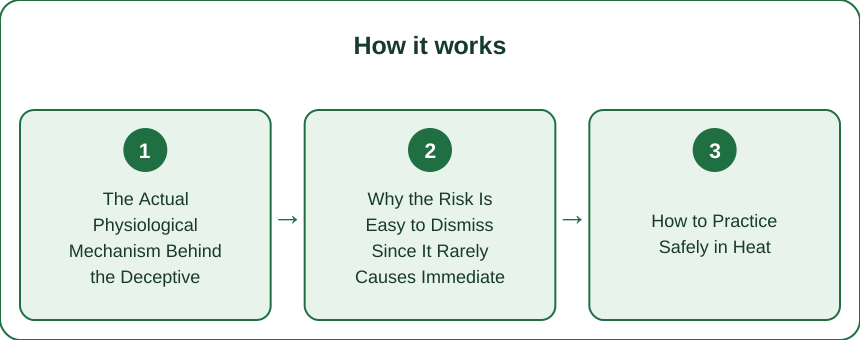
How Do You Practice Safely in Heat?
Three rules, in order of importance.
1. Treat the range as borrowed. Any newly accessible depth in a heated room is a temporary, heat-enabled state — not a new baseline to push from. Enjoy it; don’t bank on it.
2. Stop noticeably short of maximum. Deliberately leave a margin — a useful mental target is around 80–90% of the depth heat makes momentarily available. Build the margin in specifically because tissue strength hasn’t caught up to that range. If a stretch feels like the absolute end of what’s possible, you’re past where you should be in a hot room.
3. Be conservative in your first several classes. During the first few sessions of a new heated practice, your body is adapting to the heat exposure itself on top of the movement demands. Both loads are new at once. Go noticeably easier than you would in a room-temperature class, and give yourself 4–6 sessions before treating it as a normal practice.
Two supporting habits: hydrate before and after (heat plus exertion is a real fluid load), and use props rather than depth to make a pose feel like it’s working — a block that raises the floor is a better answer than a hamstring pushed past its support.
Myth vs Fact
Myth: If you can reach it, your body is ready for it. Fact: In a heated room, reachable and supportable are two different things. The heat moves one of those and not the other.
Myth: Pain is a reliable stop signal in hot yoga. Fact: It’s less reliable there than elsewhere, because heat and relaxation can dull it. Depth judgment has to be more deliberate, not more instinctive.
Myth: Hot yoga builds flexibility faster than regular yoga. Fact: It makes you feel more flexible immediately. Actual long-term gains come from consistent practice regardless of temperature, and the felt difference in class is largely temporary.
Myth: Feeling fine after class means nothing went wrong. Fact: The delayed-feedback problem is the whole issue. Next-morning soreness in a joint or a specific tendon, rather than general muscle soreness, is worth paying attention to.
When Should You See a Professional?
Get checked if you have: pain localized to a joint rather than a muscle belly, pain that appears the day after class and persists beyond a few days, any sensation of instability or giving way, numbness or tingling, or a sharp pain you felt at a specific moment in a pose.
Also worth a conversation with your doctor before starting hot yoga if you’re pregnant, have cardiovascular conditions, low blood pressure, are hypermobile (heat plus hypermobility is a particular combination worth discussing), or take medications that affect heat tolerance or hydration.
Mini FAQ
Is hot yoga bad for you?
No — it’s a legitimate practice with real benefits, and the overstretching risk is manageable rather than disqualifying. The issue isn’t heat itself; it’s practicing in heat with the same depth instincts you’d use in a cool room.
How hot is too hot?
Studios commonly run anywhere from 32°C to 40°C (90–105°F). The higher end places more strain on both tissue judgment and heat tolerance, so it’s a reasonable place to start lower if you’re new and work up.
Should beginners avoid hot yoga entirely?
Not necessarily, but starting with a room-temperature class to learn the poses — and your honest range in them — makes the heated version considerably safer. You’ll know what your baseline actually is, which makes it much easier to notice when you’ve exceeded it.
TL;DR:
- Heat increases range of motion genuinely, but not tissue strength at that new range.
- Heat can dull the protective pain signal, and overstretch pain is often delayed until after class.
- Treat heat-enabled range as borrowed, not as a new baseline.
- Stop at roughly 80–90% of what’s momentarily accessible; use props instead of depth.
- Be extra conservative for the first 4–6 heated classes, and see a professional for joint-specific or persistent pain.
Heat lends you range. It doesn’t lend you the strength to support it, and it quiets the alarm that would normally tell you so. Practice like the extra depth is on loan — because it is.
See It in Motion
Seen here: Crewneck Short Sleeve Workout T-Shirt — shop it on bubblelime.com
Keep Reading
This article is for general informational purposes only and is not medical advice. Always consult a qualified health professional for guidance specific to you.