Why Hot Yoga Makes You Nauseous the First Few Classes (And When It Stops)
Quick Answer: Early hot yoga nausea usually comes from a combination of dehydration, low blood sugar, and your body’s unadapted response to heat stress — all three typically improve significantly within 2-3 weeks of consistent classes as heat acclimation develops.
Twenty minutes into your first hot yoga class, the room starts spinning slightly and your stomach turns. You’re not the only one this has happened to — it’s common enough that most instructors have a go-to response for it.

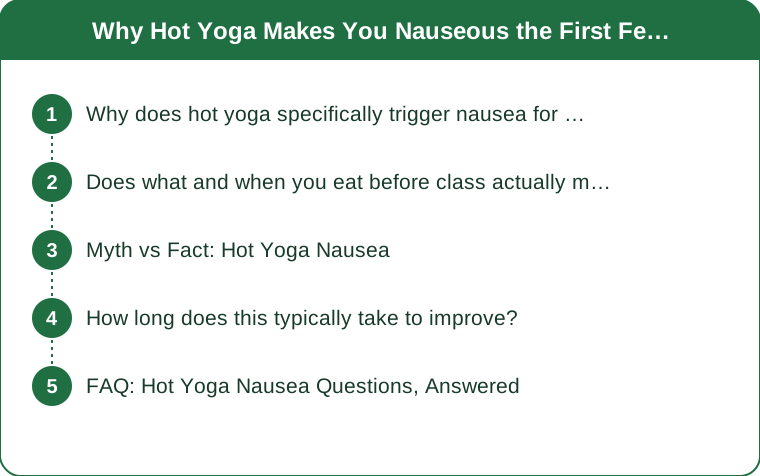
Why does hot yoga specifically trigger nausea for beginners?
Because heat stress redirects blood flow toward the skin for cooling, temporarily reducing blood flow to the digestive system, which can create a nauseated sensation, especially if there’s food still being digested.
Dehydration compounds this — even mild dehydration reduces blood volume, making your body work harder to manage both heat regulation and normal function simultaneously, which shows up as lightheadedness and nausea.
Does what and when you eat before class actually matter?
Yes, significantly — eating a large or heavy meal within 2 hours of a hot yoga class leaves food actively digesting during heat stress, which is one of the most common and fixable causes of early-class nausea.
A small, easily digestible snack (like a banana or a few crackers) about an hour before class, rather than a full meal or nothing at all, tends to prevent both low blood sugar and digestion-related nausea.

Myth vs Fact: Hot Yoga Nausea
Myth: Feeling nauseous means you’re detoxing or the class is working extra hard. Fact: nausea is a stress response signal, not evidence of a deeper cleanse — it means your body needs better hydration, fueling, or heat adaptation, not that anything beneficial is happening.
Myth: You should push through nausea to build tolerance. Fact: stepping into child’s pose or briefly leaving the room when nauseous is the appropriate response — pushing through can lead to fainting or more serious heat-related issues.
How long does this typically take to improve?
Most people notice meaningfully less nausea by class 4-6, correlating with the same heat acclimation window seen in other heat-based exercise research (roughly 2 weeks of consistent exposure).
Consistency matters more than intensity during this window — attending 2-3 times weekly during the first month builds adaptation faster than sporadic, less frequent classes.
FAQ: Hot Yoga Nausea Questions, Answered
Should I skip class entirely if I usually feel nauseous?
Not necessarily — adjusting hydration and pre-class eating first is usually more effective than skipping, since avoidance doesn’t build the heat adaptation that resolves the issue long-term.
What should I do in the moment if I start feeling nauseous during class?
Move into child’s pose, focus on slow breathing, and sip water — if it doesn’t improve within a few minutes, stepping outside the room briefly is the appropriate next step.
Is it normal to still occasionally feel nauseous even after adapting?
Occasional mild nausea, especially in an unusually hot room or after a poor hydration day, can still happen even for experienced practitioners — it’s the frequency and severity that should decrease with adaptation, not necessarily reach zero.
TL;DR:
- Early hot yoga nausea usually comes from dehydration, blood sugar, and unadapted heat response
- A large meal within 2 hours of class is one of the most common fixable triggers
- Nausea is a stress signal, not a sign of a deeper detox — don’t push through it
- Most people see real improvement by class 4-6 with consistent attendance
Before your next class, check your hydration and timing of your last meal — those two factors resolve most early nausea on their own.
See It in Motion
Seen here: High Waist Bootcut Yoga Pants with Side Pockets — shop it on bubblelime.com
Keep Reading
This article is for general informational purposes only and is not medical advice. Always consult a qualified health professional for guidance specific to you.