What Your Hot Yoga Instructor Actually Means: 6 Confusing Cues Decoded
Quick Answer: Most confusing hot yoga cues translate to specific physical instructions once decoded — ‘find your edge’ means the point of sensation just before strain, not maximum stretch, and ‘melt’ usually means relax unnecessary tension, not literally soften your effort. Knowing the literal meaning prevents both under- and over-doing poses.
You’re holding a pose, sweating, and the instructor says something like ‘breathe into the space’ or ‘find your edge’ — and you have no idea what to actually do differently with your body. These cues aren’t filler; they map to real physical adjustments once you know the translation.

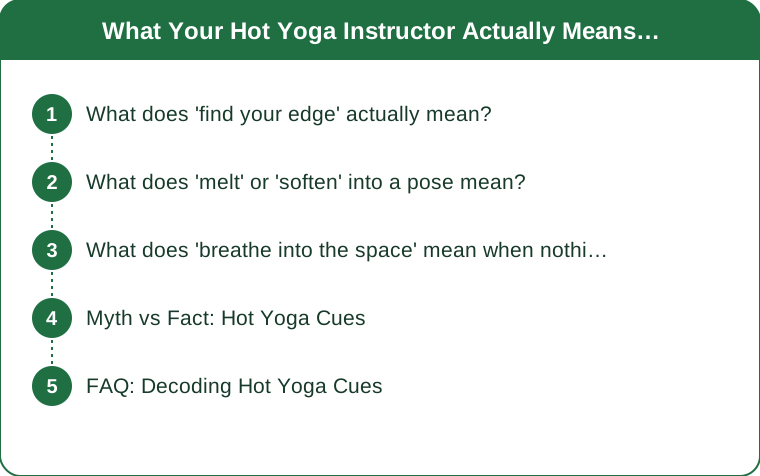
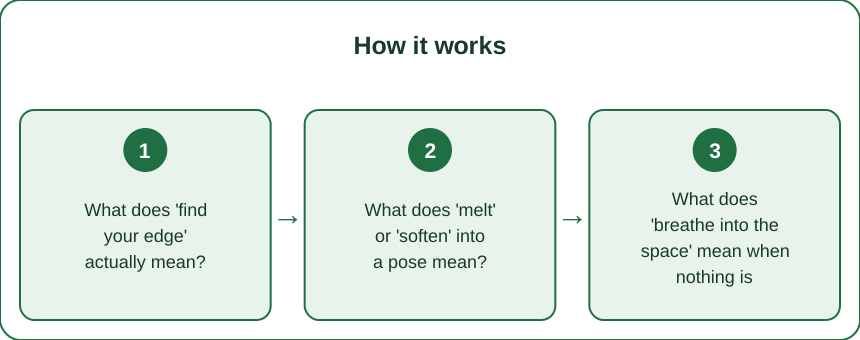
What does ‘find your edge’ actually mean?
It means the point of noticeable sensation or mild discomfort, just before anything sharp or painful — not your maximum possible stretch. Pushing to true maximum range regularly increases injury risk; ‘edge’ is intentionally short of that, asking you to work at your real current capacity rather than forcing a deeper position.
What does ‘melt’ or ‘soften’ into a pose mean?
This usually means release tension you’re holding that isn’t actually needed for the pose — clenched shoulders, a gripped jaw, or unnecessary bracing in muscles not doing the actual work. It’s not an instruction to reduce effort in the muscles that are supposed to be engaged, just to drop the extra tension layered on top.

What does ‘breathe into the space’ mean when nothing is moving?
Physically, breath doesn’t reach a specific joint the way the phrase implies — but focusing your attention and slow inhales on a tight area does tend to reduce the guarding reflex (an unconscious muscle tightening in response to stretch sensation), which can create a small amount of real additional ease in the position.
Myth vs Fact: Hot Yoga Cues
Myth: ‘Find your edge’ means go as deep as you can. Fact: it specifically means stopping short of your maximum, at the point of clear sensation without strain.
Myth: These cues are just filler language with no real meaning. Fact: most trace back to specific physical or attentional instructions, even when the wording is abstract or poetic.
Myth: If you can’t ‘feel’ what a cue means, you’re doing yoga wrong. Fact: cue interpretation is a learned skill — most regular practitioners took months of classes before these phrases mapped to something concrete in their body.
FAQ: Decoding Hot Yoga Cues
Is it okay to ask an instructor to clarify a cue after class?
Yes, and most instructors welcome it — cue clarity questions are common, especially from people newer to a specific studio’s teaching style or vocabulary.
Do all studios use the same cues with the same meaning?
Mostly, but not perfectly — teaching lineages vary slightly, so a cue’s exact meaning can shift a little between instructors or styles, which is worth noting if you switch studios.
Should I ignore a cue if it doesn’t make sense to me?
No — rather than ignoring it, defaulting to your own sense of a safe, moderate effort level in the pose is the safer approach while you build familiarity with what specific cues mean for your body.
TL;DR:
- ‘Find your edge’ means noticeable sensation short of strain, not your deepest possible stretch
- ‘Melt’ or ‘soften’ targets unnecessary tension, not the muscles actually doing the pose’s work
- ‘Breathe into the space’ is about reducing the guarding reflex, not literally directing air anywhere
- Cue interpretation is a learned skill — it’s normal to need months before these fully click
See It in Motion
Seen here: Super High Waist Embossed Yoga Leggings with Inner Pocket — shop it on bubblelime.com
Keep Reading
This article is for general informational purposes only and is not medical advice. Always consult a qualified health professional for guidance specific to you.